The Best Online Neurological Rehabilitation Programs: An Honest Comparison
If you're searching for an online neurological rehabilitation program, you deserve a straight answer — not a sales pitch. Here's an honest breakdown of what's actually available, what each approach delivers, and how to decide what's right for your situation.

I'm going to do something in this post that most companies won't: tell you when we're not the right fit for you.
If you've been searching for an online neurological rehab program, you already know the landscape is a mess. Vague promises. Prices hidden behind three forms. "Adaptive fitness" that's really just a video library. Everybody sounds the same, and nobody tells you the trade-offs.
So here's the straight version — hospital telehealth, nonprofits, subscription platforms, and LWA — including where we fall short. I have ataxia, and I like to call it MS on steroids. I came out of the hospital in a wheelchair, unable to touch my own nose, with neurologists telling me that chair was as good as it was going to get. Today I walk, drive, travel, and live alone — completely independent. I got there through this exact category of work, so I'm not comparing these options from a marketing desk. I'm comparing them from the other side of the climb.
My goal here is that you land in the right program. Even if that program isn't mine.
Why Online Rehab Isn't the Consolation Prize
Ten years ago "online rehab" barely existed. Today it's a real category, and not just because it's convenient.
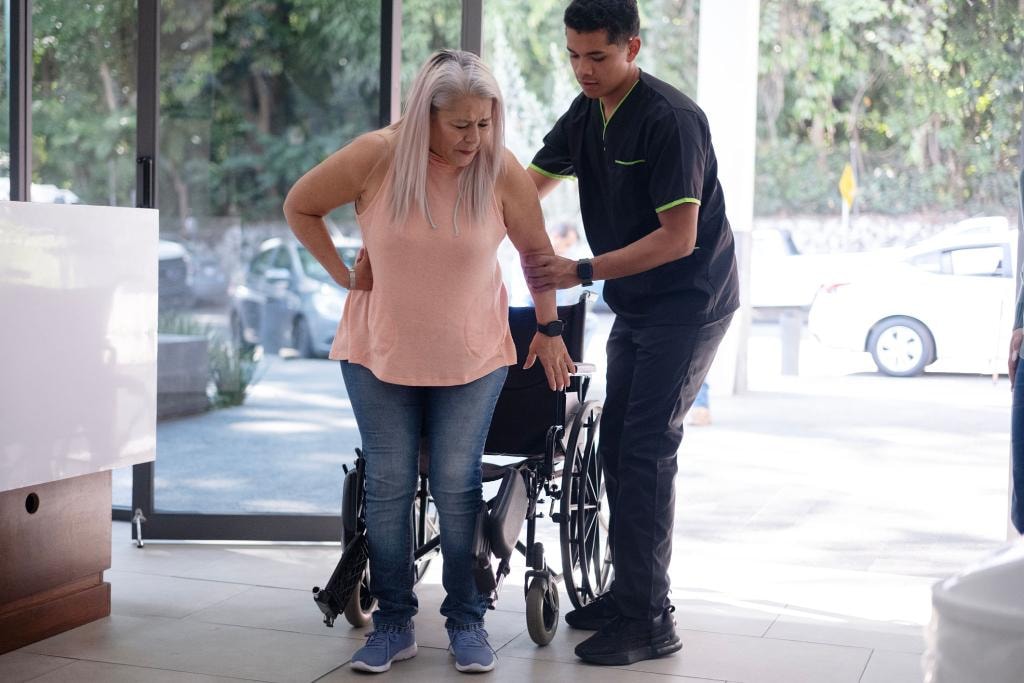
Here's the part that gets missed: you train in your actual environment. Your floor. Your stairs. Your kitchen. Your bathroom at 2 a.m. when your legs aren't cooperating. A clinic is a controlled space that doesn't look anything like the life you're trying to get back. Skills you build in your own house don't have to transfer anywhere — they're already home.
The research on telerehabilitation across MS, Parkinson's, stroke, and ataxia lines up on this: remote programs produce outcomes comparable to in-person when the programming is individualized and the person actually does the work.
Read that condition again, because it's carrying the whole sentence. Generic exercise videos don't count. A PDF of stretches doesn't count. If nobody is building it around your deficits, it isn't rehabilitation. It's content.
Six Questions to Ask Any Program Before You Pay
Before you compare anybody — including us — run every option through these.
1. Is it built for your nervous system, or just your muscles? Neurological rehab is not adaptive fitness. A neurological walking problem is a wiring problem, not a weak-legs problem. If a program treats it like an orthopedic injury — strengthen, stretch, repeat — it was never designed for your actual problem.
2. Is it individualized? Two people with the same diagnosis can have completely different deficits. If nobody assessed you specifically, you're getting somebody else's program with your name on it.
3. Does it use progressive overload? This is how neuroplasticity works. The brain rewires in response to real challenge and heavy repetition. A program that keeps you at the same level forever isn't producing change — it's maintaining you. That's the difference between rehab and a holding pattern.
4. Does it take nutrition seriously? Neurological function runs downstream of what you eat. Exercise gives the brain the signal to change; nutrition gives it the material to change with. At LWA we push a carnivore or at minimum a carnivore-leaning diet, the same approach doctors like Shawn Baker, Anthony Chaffee, and Ken Berry have been putting on record for years. Straight talk so nobody's blindsided: it will not lower your cholesterol. That's fine and expected — cholesterol is a building block for your brain. And that right there is the fight in a nutshell: the whole machine chases a number on a lab report while almost nobody asks what a drug or a diet is doing to how you move, balance, and function today. A statin handed to a neurological patient should set off alarm bells, and it usually doesn't. If a rehab program treats food as an optional add-on, it's leaving a huge chunk of your result on the table.
5. Is there a human being holding you accountable? Online programs live and die on this. No check-ins, no adjustments, nobody who knows your case — most people drift inside of six weeks. Not because they're weak. Because that's what happens without accountability.
6. Does the person running it actually know what this feels like? Credentials matter — a lot. But so does lived experience. There are things about a bad week, a fall in your own kitchen, or the day a doctor says "manage it" that no textbook covers.
Hospital-Based Telehealth Programs
Mayo, Cleveland Clinic, Johns Hopkins, Shepherd Center and other major systems offer telehealth rehab, usually delivered by licensed PTs and OTs over video.
What they do well. Credentialed clinicians. Insurance coverage in a lot of cases. Real diagnostic muscle and coordination with your physicians. If your medical situation is complicated, that oversight is worth having.
Where they fall short. Sessions run 30–60 minutes, one to three times a week, for a limited number of weeks. And the goal — say it out loud — is usually "functional baseline." Safe enough to manage at home. That's the ceiling written into the model. Waitlists are long. Worst of all, the program ends when your coverage ends, not when you've reached your potential. I've watched people get cut loose right before the breakthrough.
Best for: people who need insurance coverage, people early in recovery who need clinical oversight, and anyone with a complex medical picture that requires close physician coordination.
Condition-Specific Nonprofit Programs
The National MS Society, Parkinson's Foundation, National Ataxia Foundation and similar groups run or refer to exercise programs. Quality varies wildly.
What they do well. Often free or close to it. Real community. Condition-specific focus and good information.
Where they fall short. Most of it is group classes, not individualized programming, and the intensity is low by design — it has to be, because the class has to work for everybody in it. These are built for maintenance and connection, not for someone chasing significant functional gains.
Best for: supplementing a primary program, and for community — which is not a small thing. Isolation makes every part of a neurological condition worse.
Generic Online Fitness Platforms
Subscription platforms selling "neuro fitness" or "adaptive exercise," mostly pre-recorded video.
What they do well. Cheap. Accessible. Some of the content is genuinely decent, and moving beats not moving every day of the week.
Where they fall short. A recording can't assess you. It can't see that your left side is lagging, that your gait falls apart at minute four, or that you're compensating in a way that's going to cost you later. It can't progress you. It's better than nothing. It is not rehabilitation, and anyone selling it as such is stretching the word.
Best for: low-cost supplemental movement alongside something real.
LWA Strong — Including Where We Don't Measure Up
LWA is a remote neurological rehabilitation program built for people who want real functional gains, not maintenance. We work with ataxia, MS, Parkinson's, stroke, TBI, ALS, cerebral palsy, transverse myelitis, peripheral neuropathy, spinal cord injury and more. If it's neurological, ask us.
What we do well:
- Fully individualized programming built around your specific deficits, your goals, and where you actually are today — not a template with your name at the top.
- Progressive overload in every phase. We raise the challenge as your nervous system adapts, because that's the only thing that drives adaptation.
- Nutrition as the foundation, not an upsell. Every package includes nutritional guidance. What scales with tier is depth, never presence. You cannot rebuild a nervous system on bad fuel.
- The whole system, not just the workout. Sleep, breathing, cold therapy, spasticity, speech and swallowing — they all feed each other, and we treat them like one machine instead of six unrelated topics.
- A human in your corner who knows your case, reads your food journal, watches your video, and adjusts.
- Pre- and post-stem-cell rehab. If you're considering or recovering from stem cell treatment, the rehab on either side of it is what decides how much you keep. I'm the first person with ataxia to get stem cell treatment, done by R3 Stem Cell — two down, a third coming — so this isn't theory for me. Worth being clear: my independence came before any of that, built on exercise and nutrition. The stem cells were the cherry on top, not the cause.
- Lived experience. I've been in the chair. I know what this takes and I know what it costs.
Where we fall short — no spin:
- We don't take insurance. Our programs are out of pocket. For some people that's the end of the conversation, and I'd rather you know that in paragraph one than after a sales call.
- We're not a substitute for medical care. If your situation needs close physician oversight, you need that team. We're the piece your medical care is missing, not a replacement for it.
- We require real commitment. This program is hard on purpose. If you're not ready to work, we're not the right program and I'll tell you so on the consultation.
Best for: people who are done accepting "just manage it." People who want to push past baseline. People willing to invest in a program that takes their goals as seriously as they do.
About the Guarantee — Let's Be Precise
You'll see "INDEPENDENCE GUARANTEED" on everything we put out, and I want to be exact about what it means, because a promise you have to squint at isn't a promise.
The guarantee lives on our Ultimate All-Around package: wheelchair or walking aids to walking independence. It holds when your mobility checklist is completed to 100%. We do our side all the way; you do yours. No checklist at 100%, no guarantee. That's how the promise stays real instead of being words on a page.
And here's the honest part most companies would cut: not every client reaches full independent walking. These conditions are complicated and some are going to prevent it — the free consultation is where we figure that out and tell you the truth. Even then, we guarantee a meaningful level of independence, because independence was never only about walking. It's ordering your own food. Driving yourself. Living on your own terms.
What I can tell you flat out: every client who truly commits makes progress. Every single one.
How to Decide
If you need insurance coverage: start with hospital-based telehealth. Take everything insurance will pay for. When coverage runs out and you're not done — and you probably won't be done — come see us.
If you're not sure you're ready for intensive work: start with a nonprofit program or a low-cost platform. Get moving. Build the habit. Come back when you want to push.
If you've already done traditional PT and hit a plateau: this is exactly who we're built for. The plateau is not your ceiling. It's just where the insurance-funded program stopped.
If you want real functional gains and you're ready to invest: book the free 30-minute Zoom consultation and we'll tell you honestly whether we're the right fit. Sometimes the answer is no. You'll get that answer straight either way.
The Bottom Line
The best online neurological rehabilitation program is the one that matches your goals, your situation, and your willingness to work. That might be us. It might not be. I'd rather you find it than flatter me.
But hear this part, because it's the whole reason LWA exists: most neurological conditions are progressive when you take the wrong approach. We have the right approach. A program built around keeping you comfortable and stable will do exactly that — keep you comfortable and stable while you slowly lose ground. A program built around independence aims at something else entirely.
If your goal is to manage your condition, there are plenty of options above and some of them are good.
If your goal is to take your independence back — I'd like to talk to you.
Get Comfortable With Being Uncomfortable That's the LWA way. Knowing your enemy is half the battle — and this time the enemy was a program that was never aiming high enough for you in the first place.
Ready to compare us against whatever else you're looking at — with ataxia, MS, Parkinson's, stroke, TBI, ALS, cerebral palsy, or any neurological condition? Book your FREE 30-minute Zoom consultation and we'll give you the straight answer about whether we're the right fit.
INDEPENDENCE GUARANTEED.
LWA — Helping People With ALL Disabilities.
Explore Topics
Written by
Art Thomas
Content creator and writer sharing insights and stories.